


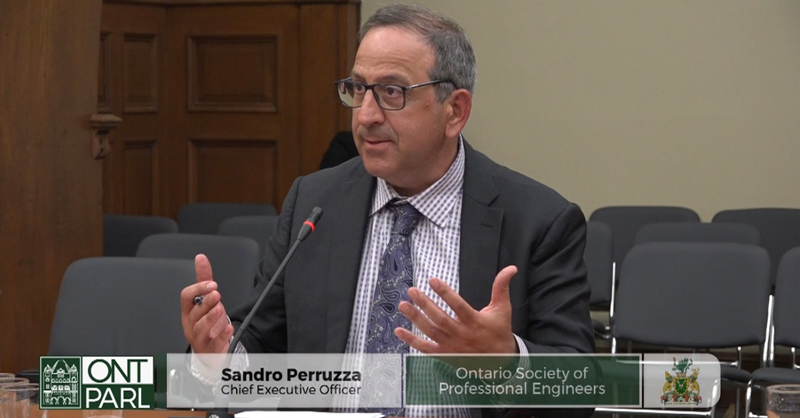
2025 was a landmark year for the Ontario Society of Professional Engineers (OSPE). Across every major file — workforce, mobility, energy, infrastructure, regulation, innovation, and national competitiveness — OSPE delivered concrete outcomes that strengthened the engineering profession and advanced public policy, not only in Ontario, but across Canada.
This year, OSPE’s advocacy shaped legislation, informed investment decisions, and guided governments toward better, evidence-based policy grounded in engineering expertise. We remain committed to ensuring that Engineers are at the decision-making table when it comes to policy development and critical project delivery, especially during this truly pivotal time.
Below are the highlights of a truly transformational year.
1. Engineering Mobility & Workforce Modernization
Bill 2 — Professional Mobility for Engineers
OSPE played a direct and influential role in the development of Bill 2, legislation designed to remove barriers for engineers working across provinces. For the first time, Ontario aligned with other provinces to form a national vision for labour mobility that recognizes engineers as critical to the country’s economic competitiveness.
OSPE’s input ensured:
- Faster, clearer pathways for engineers to work interprovinciallyma
- Reduced red tape that has hindered talent recruitment for major projects
- Encouraged National consistency in professional licencing expectations
- Engineers remain integral for the design and development of major infrastructure projects.
National Licensing Framework for Engineers
Recognizing the need for a single national licencing system, OSPE convened and supported the creation of a national Engineering Licence working group . This group is now developing recommendations for a future national licensing model that will strengthen mobility, reduce duplication, and improve public confidence in engineering regulation across Canada.
Fee Guidelines Issued
OSPE successfully issued updated Fee Guidelines, giving engineers and clients a modern, transparent benchmark for professional engineering services, and included information as to what considerations go into Engineering Fees for practitioners.
STEM Education Funding
The provincial government committed new, meaningful funding for STEM education — a shift that follows OSPE’s years-long advocacy emphasizing workforce readiness, skills development, and early engineering exposure for students. This one-time funding allotment is a good step in the right direction, but much more needs to be done to ensure consistent, stable funding for universities to develop the next generation of engineers.
2. Energy, Climate & Infrastructure Leadership
Ontario’s Integrated Energy Plan Reflects OSPE’s Priorities
Ontario’s 2025 energy plan incorporated many of OSPE’s long-standing recommendations, including:
- Integrated system planning
- Better access to engineering data
- Support for non-wires alternatives
- Long-term energy security and resiliency strategies
Historic Provincial Investments in SMRs
After years of OSPE advocacy, the province made major investments in Small Modular Reactors (SMRs) — supporting innovation, grid reliability, and clean baseload power. Engineering voices were instrumental in shaping this outcome.
Advancing Thermal Networks
Through collaboration with leading experts and industry partners, OSPE positioned thermal networks as a cornerstone of climate adaptation and decarbonization strategies in the GTHA and beyond. We will continue to work with new partners, including Municipalities, on broadening the use and integration of Thermal Networks into Ontario’s Energy Grid.
QBS (Qualifications-Based Selection) Pilot in Toronto
Thanks to persistent advocacy, the City of Toronto launched its first-ever QBS pilot project. This represents a breakthrough for procurement reform, setting a precedent for municipalities across Canada to prioritize qualifications, value, and safety over lowest bid.
Bike Lane Safety & Engineering Standards
OSPE’s evidence-based positions on cycling infrastructure were reflected in a 2025 Ontario Superior Court ruling, reinforcing the importance of engineering guidance in roadway design and municipal liability.
Indoor Air Quality
OSPE and its Indoor Air Quality (IAQ) Working Group, provided evidence-based guidance on improving air quality and reducing the transmission of viruses with a series of reports and committee appearances. Health Canada published indoor air quality guidance that aligns with OSPE recommendations.
3. Industrial & Economic Engineering Leadership
A Canadian Industrial Policy — OSPE at the Table
OSPE advocated strongly for the creation of a Canadian industrial policy to rebuild the country’s manufacturing base and drive innovation-led growth. This year, OSPE’s recommendations influenced federal discussions on competitiveness, workforce development, and advanced manufacturing.
Participation in the Ontario Chamber of Commerce (OCC) Business & Trade Leadership Coalition
OSPE CEO Sandro Perruzza represented the Society on the Ontario Chamber of Commerce’s Business & Trade Leadership Coalition, a group focused on creating strategies to help Ontario businesses navigate new tariffs, strengthen supply chains, and maintain competitiveness. Through Sandro’s participation, OSPE ensured that engineering expertise and technical insights informed provincial and federal discussions on trade resilience, economic growth, and the long-term health of Ontario’s industrial ecosystem.
This led to the development of a trade and tariffs information page on the OSPE website, which includes programs to help engineering employers support their businesses and grow their talent capabilities.
4. Artificial Intelligence (AI), Innovation & Emerging Technologies
National AI Policy Development
OSPE — through its AI Working Group — participated in a national survey to inform Canada’s emerging AI policy framework. Engineers provided critical insights into safety, accountability, and standards for AI-enabled systems.
This ensures engineering ethics, risk management, and public protection are at the centre of Canada’s AI evolution.
5. Federal Budget 2025 — Major Wins for Engineers
On November 4, the 2025 Federal Budget included significant commitments aligned with OSPE’s advocacy priorities as outlined in our budget submission to the federal government, this includes:
- Over $115 billion in infrastructure funding over five years
- Tax incentives supporting:
- research
- clean growth
- advanced manufacturing
- clean and renewable energy
- Strategic investments in:
- grid modernization
- low-carbon and resilient systems
- defense infrastructure
- next-generation technologies (AI, quantum, robotics)
For engineers, this translates into expanded opportunities, forward-looking project pipelines, and major nation-building initiatives requiring deep technical expertise.
OSPE will continue engaging federal partners to ensure engineering knowledge shapes implementation and workforce planning.
6. Supported the establishment of the British Columbia Society of Engineering and Geoscience
A new advocacy and members’ services group, similar to OSPE, has opened its doors in British Columbia, servicing engineers and geoscientists in the province. OSPE’s CEO, Sandro Perruzza, was involved in the creation of this organization. A group of engineering leaders incorporated the body, gave it its name, and recruited its inaugural Board of Directors. OSPE continues to support the growth of the new body through the licensing of the Engineering Academy and sharing knowledge, experience and resources.
Looking Ahead
2025 proved that when engineers speak with a unified voice, and when OSPE brings evidence, clarity, and solutions; governments listen.
From energy and mobility to AI and national competitiveness, OSPE’s advocacy reshaped policy across multiple jurisdictions. The wins are real, measurable, and already providing a positive impact on the profession, the province and the country.
In 2026, OSPE will continue to give our members a voice through the following initiatives:
- Push for a National Engineering License option for practitioners who work in multiple jurisdictions
- Expand QBS adoption across municipalities and into provincial procurement agencies
- Continue driving Canada’s industrial strategy
- Strengthen engineering’s role in energy and climate resilience
- Advocate for equity, accessibility, and workforce development in the profession
- Ensure engineers continue to lead the next generation of infrastructure development and innovation strategy
This year was historic, and it sets the stage for even greater impact ahead.




Leave a Comment