

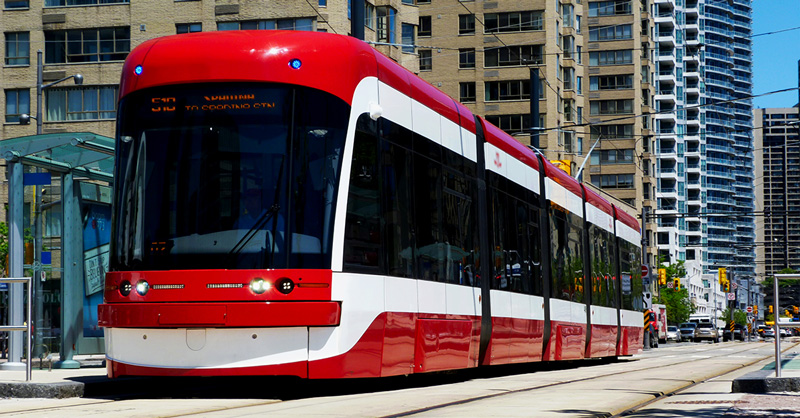
Major investments in surface rapid transit are reshaping mobility in Toronto. Lines such as TTC Line 6 Finch West, surface operations on TTC Line 5 Eglinton, and the city’s legacy streetcar network are intended to deliver faster, more reliable travel while supporting long-term urban growth.
To help ensure these investments deliver their intended outcomes, the Ontario Society of Professional Engineers (OSPE) recently sent a technical letter to Michael Lindsay, CEO of Metrolinx, and Mandeep S. Lali, CEO of the Toronto Transit Commission (TTC). A similar letter was also shared with Toronto Mayor, Olivia Chow, and Toronto’s City Manager.
The purpose was straightforward: to offer engineering observations on how operational performance; including speed, intersection delay, and service reliability, can influence the success of surface rail systems.
Importantly, OSPE’s comments are not about transit mode selection or project justification. Instead, they focus on how systems perform once they are operating.
Across many cities, surface rail systems achieve strong performance when operational elements work together: transit signal priority, appropriate stop spacing, protected rights-of-way, and effective conflict management with road traffic. When these factors are applied consistently, surface rail can provide reliable, competitive travel times even in dense urban environments.
In Toronto, early operating experience and publicly reported data suggest that there may be opportunities to strengthen this alignment. Average speeds and schedule reliability on some routes fall below levels typically associated with high-performing surface rail networks.
OSPE’s letter highlights several operational principles that can influence outcomes, including consistent signal priority across corridors, maintaining right-of-way integrity, reviewing stop spacing, and ensuring operating speeds reflect the design intent of dedicated transit corridors.
The organization also emphasizes the importance of clear performance expectations and transparent reporting, particularly as new lines transition from construction into steady-state operations.
Ultimately, the goal is to support a shared objective: ensuring that Toronto’s surface rail network delivers reliable, competitive service that meets public expectations and strengthens confidence in future transit investments.
OSPE has offered to collaborate with Metrolinx, the TTC, and municipal partners in technical discussions or working groups focused on operational performance and benchmarking.
Engineering expertise can help ensure that the significant investments already made in Toronto’s transit system translate into the fast, reliable service that residents expect, and that the region’s growing transportation network requires.



Comments (2)
While transit at-grade may be the least expensive there is regular disruption attributable to utility work and road incidents. The disruptions can be avoided with elevated guideway that is carried on columns that can be located away from major utility clusters.
More elevated guideway transit in Toronto would cause less disruption to traffic and increase the safety for transit users crossing to the sidewalk.
I wouldn’t dispute with you that guideway-based light metro is faster than surface rail. Canada has been a leader in guideway-based light metro in the Montreal REM and the Vancouver Skytrain, examples that Ontario should learn lessons from. However, I would dispute that surface rail is an altogether different mode than guideway-based light metro and needs to have a design intent of the higher capacity and express mode that it has the potential to be, and leave the local services to buses and trolleybuses (if existing). If its design intent is that of a high-capacity bus replacement, then it will perform as such, if not worse, as it is a possible mismatch of modes.
Leave a Comment