


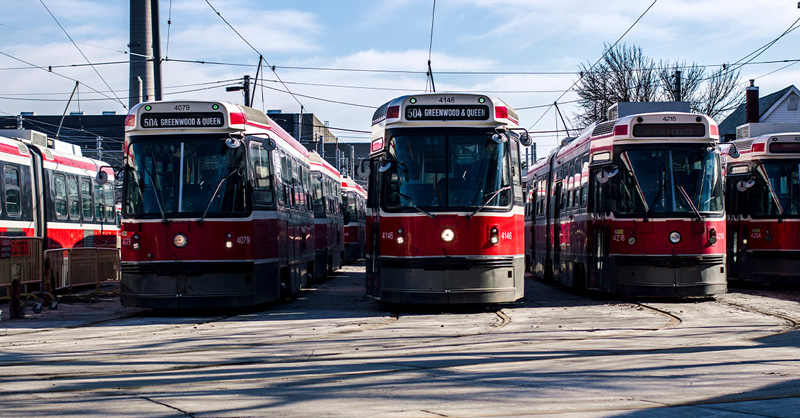
In February 2026, OSPE sent a letter to the CEOs of Metrolinx and the Toronto Transit Commission (TTC) with a straightforward message: Toronto’s surface rail network is underperforming, and the necessary fixes are well understood. Two months later, the TTC tabled a board report doing exactly what we asked, a win for OSPE, engineers, and transit riders in Toronto.
What OSPE Said
OSPE’s February letter to Michael Lindsay, CEO of Metrolinx and Mandeep Lali, CEO of the TTC pointed to specific, measurable gaps in Toronto’s surface rail network.
- Toronto’s legacy streetcar network runs at 11-12 km/h compared to an indicative range of 20-25 km/h for high-performing surface rail.
- Transit Signal Priority (TSP) operates partially and conditionally rather than as a corridor-wide system
- Stop spacing mimics bus routes rather than rapid transit, and
- On-time performance on some lines runs around 62%.
To address these concerns, OSPE offered six operational principles to implement.
- Treat signal priority as a baseline rather than a conditional accommodation.
- Align stop spacing with rapid transit objectives.
- Bring operating speeds up to what corridor design allows.
- Manage right-of-way integrity actively.
- Modernize special trackwork to reduce low-speed constraints.
- Establish transparent performance governance with real accountability across agencies.
The letter was technical and deliberate. OSPE does not advocate for mode selection or second-guess capital decisions. We advocate for performance. If the public investment has already been made, the system should work at or above the standard for comparable projects.
Action from the TTC Board
The staff report going before the TTC Board on April 16, 2026 — “Improving LRT and Streetcar Speed and Reliability” — directed to the TTC Board reads like a point-by-point response.
On signal priority: The TTC reports travel time reductions of up to 42% per intersection following recent TSP enhancements, with a target of 70 new or updated installations in 2026 and long-term plans to expand to over 800 intersections on the top 20 transit routes. Lagging left-turns, phase rotation, and green wave strategies are all being deployed — exactly the kind of corridor-level, unconditional priority approach OSPE described.
On stop spacing: A network-wide review is underway, informed by international benchmarks. The TTC’s own data shows that Toronto streetcars are slower, even compared to peers with similar stop spacing – Melbourne being one example — and that cities with 400-600 metre stop spacing run 15-50% faster. A route-by-route review is in progress.
On operating speeds: A systematic review of the Streetcar Rule Book is underway to identify restrictions that are not safety-critical. The 25 km/h limit entering intersections is being re-evaluated for both Light Rail Transit (LRT) lines. These are the kinds of rules that have suppressed speeds, even on rights-of-way, with minimal conflict.
On special trackwork: The TTC is modernizing obsolete electrically controlled switches to eliminate stop-check-go procedures, exactly what OSPE flagged under junction throughput.
On line management: Dwell time reduction, improved supervision, step-back operators, and an AI-enabled bunching and gapping tool are all in deployment. Line 5’s average round-trip travel time has improved by about 10 minutes since opening, and Line 6’s time by about 20 minutes.
Why This Is a Policy Win — and What It Means
None of these programs began the day our letter arrived. Some were already in motion; advocacy does not always mean planting a flag where nothing existed before. Sometimes it means naming the problem clearly, providing a coherent framework, and being on record when the response comes.
OSPE’s February letter put the engineering profession’s credibility behind a set of performance expectations at a moment when the TTC and Metrolinx were under pressure from City Council, riders, and the media to show results. The staff report now before the TTC Board reflects the same diagnostic logic our letter laid out: that underperformance in surface rail is not an engineering failure but a governance and operational one, and that the solutions are known and implementable.
The report also picks up something we stressed in our closing: that clear performance frameworks help executive leaders communicate operational trade-offs to Council and the public. The TTC’s commitment to report on progress in Q1 of 2027 reflects exactly that kind of accountability structure.
There is still work to do. Municipal traffic policy, curbside governance, and enforcement remain outside the TTC’s direct control, which is why OSPE’s letter was also intended to complement engagement with the City of Toronto. The TTC’s report acknowledges the same multi-jurisdictional reality, and OSPE will continue that conversation moving forward.
For more information or to engage with OSPE’s transportation advocacy work, contact us at advocacy@ospe.on.ca.
Ontario Society of Professional Engineers — Where Ontario’s engineering community works together to build a better future for all.
Interest in attending Rail Day by TRACCS later this spring. Get a discount on your booth by using the code OSPETRACCS2026 at https://www.traccs.ca/railday2026


Comment (1)
Well done for transport and other engineers that provided those recommendations. City of Ottawa could also use some help to improve reliability of the relatively new LRT (poor in wet winter conditions), and east and west extension line are built but about 2 yrs late and opening them will likely miss the Sep ‘26 start of university terms, again. Ref High Speed Train -1st link Ottawa to Montreal: this was proposed almost 40 yrs ago at an OIQ – Outaouais lecture I attended! OSPE could likely help with route selection and/or community relations and buy-in in eastern Ontario rural communities affected. Old or existing rail line corridors would seem logical, but some are too close to residences.
Leave a Comment