

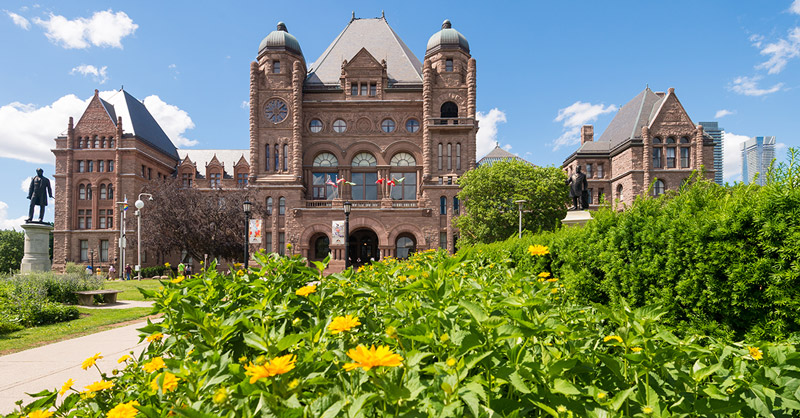
Queen’s Park is wrapping up its spring sitting. For most Ontarians, the end of a legislative session passes without much notice. For OSPE, it is a natural moment to take stock of what the engineering community brought to the policy table, and what we helped move.
How the Legislature Works, Briefly
Ontario’s Legislative Assembly sits in sessions, typically a fall sitting and a spring sitting, with breaks in between. The spring session usually runs from late February or March through June.
During this period, the provincial government introduces and passes legislation, debates the provincial budget, and holds committee hearings on proposed laws and regulations. It is the window when advocacy organizations like OSPE do some of their most concentrated work: submitting formal comments on legislation, meeting with provincial ministers and MPPs, and making the case for engineering expertise in decisions that will shape the province for years.
When the legislature rises for the summer, formal proceedings at Queen’s Park pause. Regulations can still be made, and ministry work continues, but the legislative calendar stops. That makes the spring session a critical window, and this one was a full one.
What OSPE Brought To Queen’s Park This Spring
The session opened with OSPE’s annual Lobby Day on March 23, the first sitting day of 2026. Over the course of that day, OSPE met with provincial ministers and MPPs from all parties, including Minister Todd McCarthy at Environment, Conservation and Parks and acting Minister of Infrastructure, Minister Rob Flack at Municipal Affairs and Housing, Associate Minister Sam Oosterhoff at Energy-Intensive Industries, Associate Minister Charmaine Williams at Women’s Social and Economic Opportunity, Opposition Leader Marit Stiles, and several parliamentary assistants and critics.
The conversations covered modernizing the Professional Engineers Act, building affordable and resilient cities, strengthening research and innovation, building a more inclusive engineering profession, and enabling the energy transition. Greetings at the evening reception came from all four parties at Queen’s Park, a signal that the engineering perspective is recognized across the political spectrum.
From there, the spring session produced a steady stream of substantive engagement.
In April, OSPE submitted formal comments on Bill 98, the Building Homes and Improving Transportation Infrastructure Act, to the Standing Committee on Heritage, Infrastructure and Cultural Policy. The submission supported the provincial government’s goals on housing delivery and transit integration while raising specific concerns about green development standards, water and wastewater infrastructure, and procurement. OSPE made the case for Qualifications-Based Selection as the standard for engineering services on publicly funded projects.
In May, OSPE submitted comments on the proposed amendments to the Environmental Assessment Act, introduced through the provincial Protecting Ontario’s Workers and Economic Resilience Act. OSPE supported the removal of the Cabinet concurrence requirement but raised substantive concerns about the removal of the Ministry Review comment period and the public’s right to request an Ontario Land Tribunal referral, recommending more targeted reforms that preserve accountability without sacrificing efficiency.
In April, OSPE met with Minister Stephen Lecce, Ministry of Energy and Mines to advocate for engineering solutions for Ontario’s energy system, like policy to keep energy affordable and support economic development through solutions like sector coupling that can decarbonize building heating and improve the Ultra Low Overnight (ULO) pricing plan to better serve Ontario residents.
On June 3, OSPE met with Ontario’s Attorney General Doug Downey. The conversation focused on three specific asks: restoring licensure pathways for science and technology graduates that were eliminated under the Fair Access to Regulated Professions and Compulsory Trades Act (FARPACTA), refocusing PEO’s budget on its core mandate of regulation and enforcement, and closing an insurance loophole to protect the public.
Throughout the session, OSPE also met with MPP Tom Rakocevic on Qualifications-Based Selection, attended the Ontario Chamber of Commerce roundtable with several provincial ministers to advocate for the role of engineers across policy files, and met with the 2025-2026 Ontario Legislature Internship Programme participants to discuss why technical expertise and evidence belong at the policy table.
What Moved
The spring session produced real outcomes for Ontario’s engineers at the provincial levels:
Ontario’s 2026 provincial budget, released in March, committed over $210 billion in long-term infrastructure investment across housing, transit, and community development, closely aligned with engineering priorities OSPE has been advancing on affordability, competitiveness, and supply chain resilience. Shortly after, Premier Ford and Prime Minister Carney signed the Canada-Ontario Partnership to Build, a joint federal-provincial agreement to accelerate major infrastructure delivery, address housing and transportation challenges, and strengthen domestic supply chains. Both announcements reflect advocacy positions OSPE has held consistently at both levels of government.
What Comes Next
The legislature rising does not mean advocacy pauses. Provincial regulations continue to be developed, ministry consultations proceed, and work OSPE has underway like advocating for Qualifications-Based Selection (QBS) and protecting the engineering right to practice continue.
OSPE’s role is to make sure engineers have a voice wherever decisions affecting the profession and the public are being made, at Queen’s Park, in Ottawa, and in the boardrooms where major projects take shape. This spring, that voice was heard.


Leave a Comment